

Key Takeaways
- A whimsical rug gets its character from an unexpected subject, shape, colour relationship or visual detail.
- Some designs tell their story at once. Others reveal their humour or meaning on a second look.
- Choose the kind of change your room needs before choosing the loudest or most unusual rug.
- A strong rug only needs a few links to the room, such as a repeated colour, curve or material.
- Furniture placement matters when a character, outline or directional image forms part of the design.
- Choose a subject and level of attention that will still appeal once the initial surprise settles.
Some rug searches begin with a size, a colour or a room. A search for something whimsical often begins with a screenshot and a less exact feeling: more colour, more character, perhaps an animal or shape that has not appeared in every other interiors feed. The hard part is naming what you like well enough to find it.
Our Whimsical Rugs collection brings several versions of that feeling together. There are winged animals, figures built from broad graphic curves, quiet pastel swirls, visual jokes and small scenes that happen to sit on the floor.
At Housenfriends, whimsical is not a catch-all for every bright, cute or irregular rug. We use the word for designs that seem to have a point of view: a character with its own posture, an everyday object behaving strangely, or a composition that takes a second to reveal itself. The first surprise should still leave something worth looking at once the novelty has settled.

What Does ‘Whimsical’ Mean in a Rug?
There is no single fixed definition, but a useful way to recognise a whimsical rug is to look for a small departure from the expected. An unfamiliar subject may appear where a conventional repeat would normally sit. The outer edge may follow a body, a creature or a drifting line. Two colours may meet in a way that feels painterly, slightly strange or full of movement. In practical terms, a whimsical rug uses an unexpected subject, shape, colour relationship or visual detail to make the floor feel imaginative, not purely functional.
The word describes an effect more accurately than a product type. A rectangle can be whimsical. An irregular outline may have no whimsy at all. A floral rug can feel romantic, graphic, traditional or storybook-like depending on the drawing, scale and colour. Brightness alone is not enough either. Some of the most convincing designs use a restrained palette, then introduce one curious curve or half-hidden figure.
That looseness is exactly why the search language gets muddled. The same rug might be called quirky because of an eccentric detail, graphic because of its broad shapes, or sculptural because its outline feels almost like an object. Organic usually describes contours borrowed from growth, water or landscape. Whimsical can overlap with any of these, but the word makes most sense when the design suggests imagination or a little narrative.
Whimsy Can Come from Character, Shape, Colour or a Second Look
Hide & Seek Orange Whimsical Patchwork Big Cat Shaped Rug is a useful place to begin because its whimsy is visible before any close reading. In the opening photograph, two oversized orange animal forms lean together among tropical plants. Their markings feel closer to a patchwork illustration than a conventional animal repeat, while the scale gives them the presence of soft objects or characters. Available in 63 × 120 cm and 87 × 165 cm, the same design can sit closer to an accent at the smaller size or take on much more of the room at the larger one. A clean product view later in the section lets the full shapes come back into focus after that first atmospheric impression.
With the Faye Black & Red Gothic Winged Cat Shaped Rug, you see the wings and alert profile before you start thinking about pattern. It reads as a character first. Much of its personality sits in the outer contour, not in an ornamental repeat across the surface. Here, whimsy parts company with a straightforward animal motif. The rug does more than show a cat. It hints at a character from a world that does not quite exist.
Otto Orange Dog and Blue Cat Cuddling Rug is more abstract at first glance. Orange and blue form one low, interlocking shape before the long ears, paws and two faces separate into a dog and cat. The pose still gives the rug its story, but the colour blocks do part of the work. Rugs like these belong to the wider world of animal-shaped rugs, while the shared silhouette adds something a simple animal outline may not have. Our guide to animal-shaped rugs in UK homes looks more closely at how those recognisable forms behave in a room.
Other designs take longer to reveal themselves. Nico Beige & Tan Graphic Abstract Waist Body Art Rug first appears as a calm arrangement of cream, tan and black curves. The figure arrives a moment later. At 40 × 60 cm or 50 × 80 cm, it works as a close-range accent whose subject may only become clear once you are near it. Benny Pink Goofy Fried Egg Face Shaped Rug is much less coy. Its 69 × 75 cm shape and densely tufted acrylic surface give the outline a firm, crisp presence. An everyday object has acquired a face, and now it is sitting on the floor looking back at you.
Colour can carry the idea on its own. At 120 × 180 cm, Willa Pastel Starlit Swirl Abstract High Low Tufted Rug is large enough for its drifting shapes, soft contrast and loose motion to spread across a meaningful part of the floor. There is no character to identify and no punchline to catch. Your eye can wander through it. If Willa is closer to your taste, our guide to graphic rugs and how to choose the right kind unpicks some of the distinctions, while the broader Graphic Rugs collection shows how varied that visual language can be.
You might enjoy the instant character of Faye but find the fried egg too knowing. Someone else may want Willa’s movement and have no interest in a recognisable subject. Those reactions are more useful than deciding whether you are a ‘whimsical person’. They tell you what you actually want to keep looking at.
Choose a Whimsical Rug by What You Want It to Change
A room with pale walls and white furniture may need colour, but colour is only one possible job. An empty stretch beside a sofa may need a focal point. A bedroom full of straight-edged furniture may benefit from a softer interruption. A well-furnished room can still feel anonymous, in which case one memorable subject may do more than another layer of coordinated accessories. Start with the part of the room that feels unresolved.
If the space feels flat, look for movement in the outline or composition. If it feels overly orderly, an off-centre figure or irregular edge can loosen the visual rhythm. If the room already contains several strong patterns, a recognisable shape in a limited palette may read more clearly than another detailed print. A dark room does not automatically need the palest rug available. A richer colour can give it depth, provided the floor, furniture and available light allow the design to remain visible.
The same rug can perform very different work in two homes. A winged cat beside a plain bed becomes the room’s main character. Set among colourful art, patterned cushions and collected objects, it joins an existing conversation. Think about how much of the room you want the rug to organise. It may be the starting point, or the slightly odd detail you notice after everything else.
Once you know the job, the shortlist gets smaller. You are no longer comparing twenty imaginative designs on charm alone. You are looking for colour, a scene, a softer contour or a strong centre. The rugs that do something else can be lovely and still be wrong for this room.
When a Whimsical Rug Meets the Rest of the Room
People often love a rug in isolation, then hesitate when they picture it at home. A cushion can move to another chair. A print can shift to a quieter wall. A rug sits under the furniture and takes up far more space, so its mood is harder to treat as a small accent.
Copying every colour around the room often looks more laboured than connected. One blue might return in a small artwork. A curved sofa may sit comfortably beside a rounded outline. Warm wood can pick up a tan section while leaving the stranger colours alone. A couple of such links are usually enough.
Oona Blue Water Sea Otter Shaped Graphic Rug shows how this can work. The subject is playful, yet the low horizontal composition feels settled. In a quiet room, the blue base could connect with one textile or ceramic piece while the otter remains the surprise. A second otter on a cushion would add very little. The rug has already supplied the scene.
The subject is rarely the whole problem. Scale and the space around it often decide whether a funny or fantastical rug looks confident. The same design can seem incidental if it is too small for the available floor, stranded between furniture or surrounded by unrelated focal points.
Bold rugs are not reserved for neutral rooms. A colourful interior can support another expressive piece when the colours share a temperature, a curve appears elsewhere, or one area remains visually calm. The room only needs enough connection for the rug to look chosen, not dropped in from another scheme.
Shape and Placement Decide Whether a Whimsical Rug Can Be Read
Standard rug advice tends to begin with furniture legs and floor coverage. Whimsical designs add another question: can the image still be read after the furniture arrives?
A face hidden under a bedside table becomes a patch of colour. A cuddling pair covered through the middle can lose the gesture that made it appealing. An irregular edge pushed tightly against a sofa may look accidental because the contour has no clear floor around it. Directional subjects also have a natural viewing side. Consider the doorway, the usual approach to the room and the position from which the rug will be seen most often.
The principle becomes clear with shaped rugs and conventional rectangles. A shaped piece needs enough visible perimeter for its silhouette to register. It does not require a large empty zone on every side, but the most expressive section should not disappear beneath the heaviest furniture.
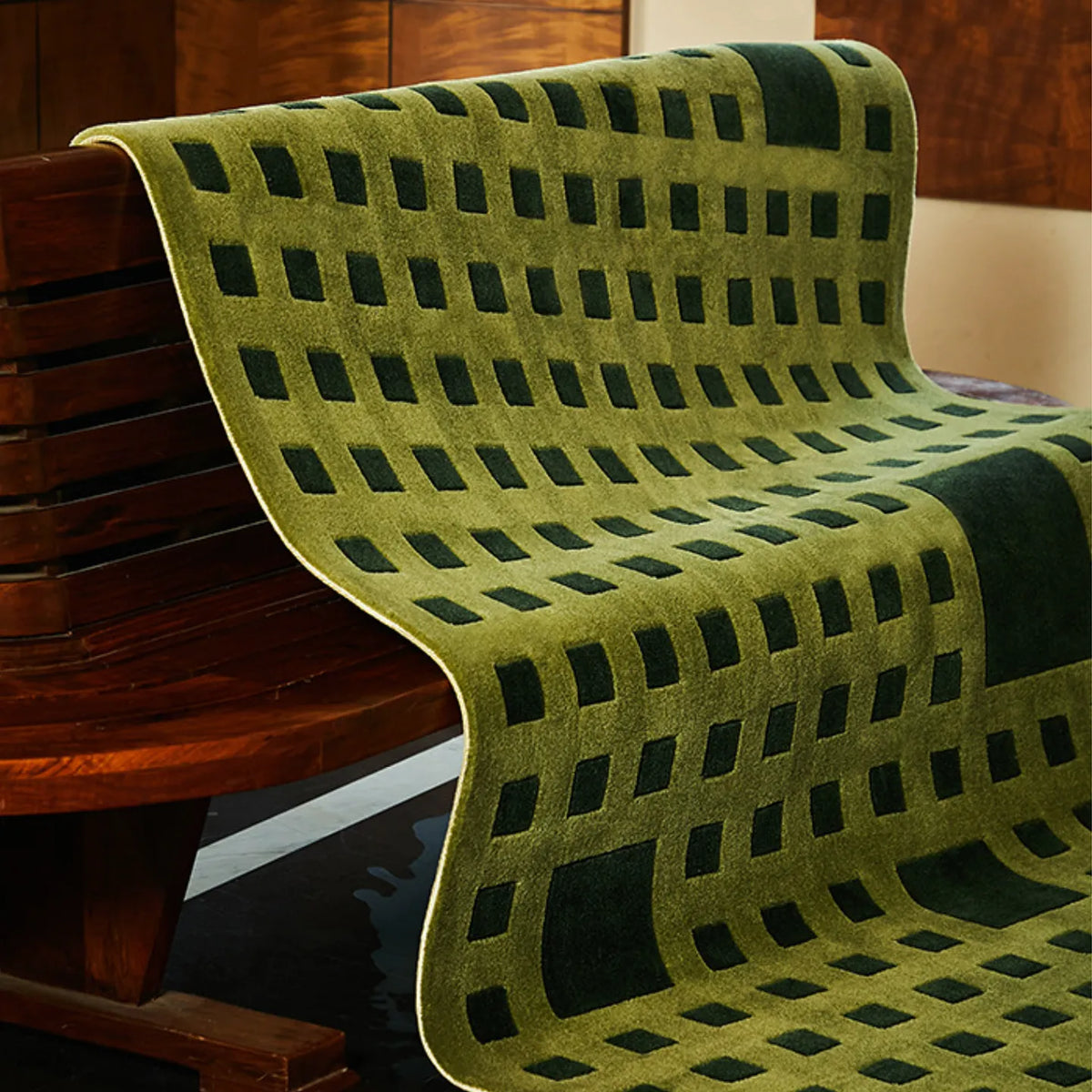
Rafi Green & Lime Wavy Striped Runner asks for a different reading. At 47 × 160 cm, its long format turns movement into a route, so the design makes sense along a hallway, beside a bed or through a narrow run. A character rug usually creates a stop. A wavy runner encourages the eye to travel. Placement should respect that distinction.
Scale changes tone as well as fit. A tiny object-like rug behaves like a visual aside. A larger figure becomes part of the room’s identity. Before choosing, mark out the dimensions on the floor, then stand at the main entrance to the room. Check what furniture will cover, where the outline breaks and whether the design still has a clear first read. A whimsical rug does not need to explain itself in one glance, but its most important idea should survive daily use.
Choosing one becomes easier once you stop treating whimsy as a single look. You may be drawn to a character that makes the room feel inhabited, a graphic curve that takes a second to reveal itself, or a colour composition that adds movement while keeping the subject open.
Look again after the first surprise. Check what the rug changes, what the room gives back and whether the design can still be seen from the places that matter. The strongest choice is rarely the one that satisfies the largest number of style labels. It is the one whose particular kind of oddness still feels right in your home. You can compare character shapes, graphic subjects, visual humour and quieter colour-based designs in the Whimsical Rugs collection.


0 comments