

Key Takeaways:
- Small kitchen rugs work best in high-use spots like sink areas, doorways, utility corners and narrow kitchen runs.
- For everyday kitchen use, textured rugs with stripes, grids or high-low lines feel practical without looking too plain.
- A 50×80 cm or 60×90 cm rug suits most sink-side spots, while 45×120 cm or 45×150 cm works better for narrow runs.
- Dense tufted rugs can add cushion, softness and surface depth in drier kitchen corners or coffee spots.
- Warm neutrals, green rugs, wavy shapes and graphic rugs can all work when matched to the right kitchen floor.
- Always check clearance, grip and care details before placing a rug near doors, drawers, sinks or busy walkways.
A kitchen rug is easiest to get right when it improves a part of the floor you use every day. In many small kitchens, including the compact UK homes we know well, the floor is broken up by cupboard doors, fridge doors, bins, dishwasher fronts and narrow walkways. A full rug can quickly feel like too much. One small kitchen rug in the right place is often enough to make the room feel softer, warmer and more considered.
Look first at the place where you actually pause. That might be the sink area, the strip in front of the worktop, a back doorway, a utility corner or a narrow run between cabinets. For one of those small kitchen spots, our small rugs are the simplest place to start.


Start with the spot where you actually stand
You notice a kitchen floor most when you are standing still, washing up, chopping vegetables, making coffee or waiting for the kettle, checking the oven or moving between the sink and the worktop. A kitchen rug has to make sense for those small repeated moments.
So the question is less "how much floor can I cover?" and more "which part of the floor do I notice every day?" The rug only has to improve one hard-working patch of floor to be worth having. Usually, it is the bit that feels cold, hard or oddly unfinished because you pass through it all the time.
It follows the same small-space thinking as Small Rugs for UK Flats That Make Compact Spaces Feel Intentional. A small rug works best when it has a clear job. In a kitchen, that job is usually comfort, placement and making one busy part of the room feel more settled.
For everyday kitchen use, start with texture that can handle movement
A kitchen rug has a slightly awkward job. It needs to feel softer underfoot without becoming precious, and it has to add something to the floor without asking for too much attention. It should still feel easy when you are rushing around with breakfast, mugs and cupboard doors open. In a small kitchen, the floor is already competing with cupboard doors, handles, appliances, bins, chopping boards, tea towels and whatever ends up sitting on the worktop.
Texture is often a better starting point than a loud print. A raised stripe, a soft grid or a quiet high-low line can do a lot in a kitchen. It gives the floor a bit of order, but still lets the cupboards, worktop and everyday clutter stay in the background.
That is especially useful near the sink, along a short cabinet run, beside a utility corner or by a kitchen doorway, where the floor gets used again and again. A completely plain mat can feel too functional. A very plush decorative rug can feel like the wrong kind of effort in a hard-working spot. The safer middle ground is texture with a bit of softness. It gives the floor enough detail to feel considered, without making the rug compete with the rest of the room.
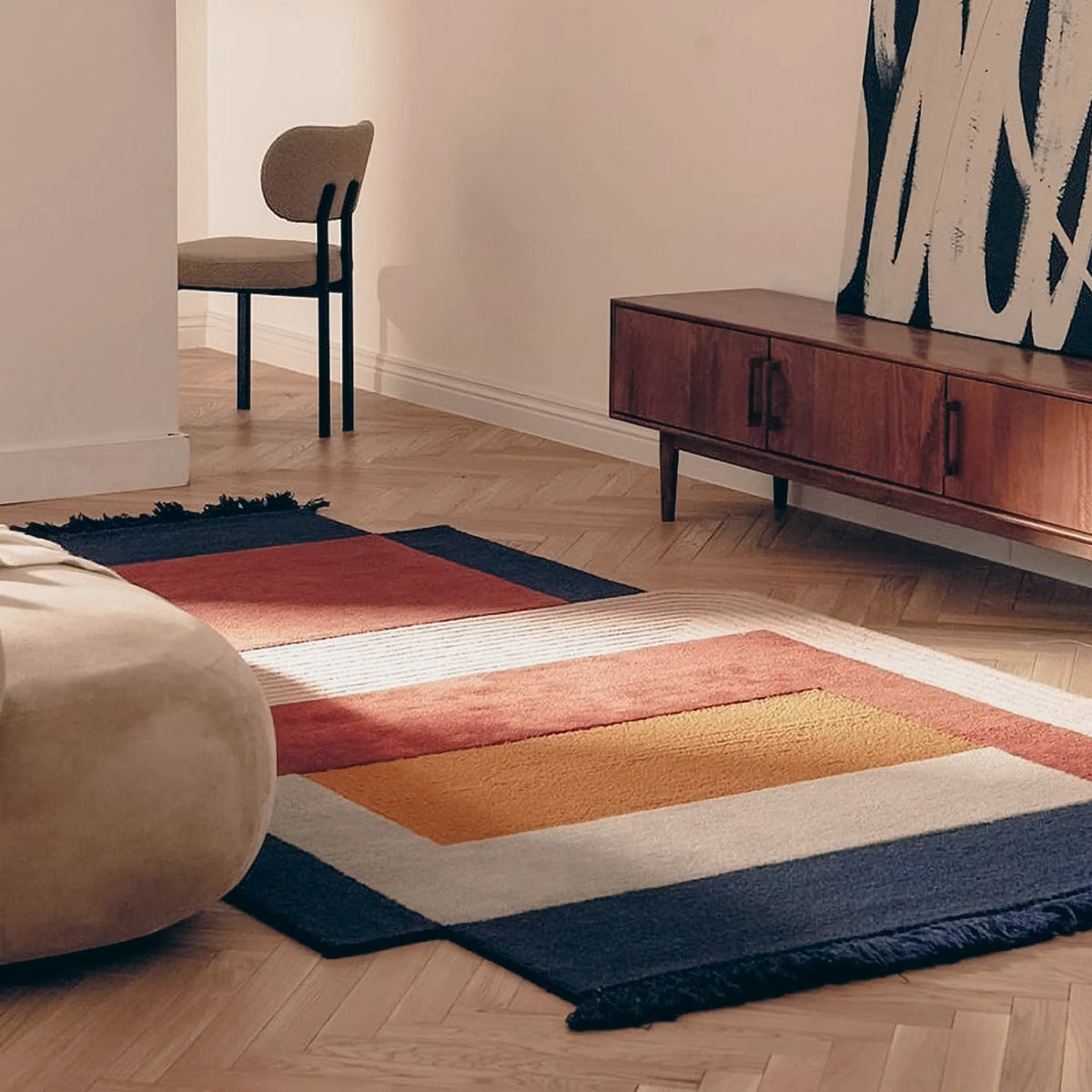
Elio Beige & Navy Striped High Low Textured Rug and Ivo Cream & Mocha Grid High Low Textured Rug sit well in that middle ground. A 50×80 cm or 60×90 cm size works neatly near a sink or utility corner, while 45×120 cm or 45×150 cm makes more sense along a narrow run. Nori Cream Curvy-Line High Low Textured Rug is better for a cleaner coffee spot or open-plan edge, while Soren Black Cream & Blue Block-Stripe Textured Rug brings more definition to a doorway or short kitchen strip.


For a softer standing spot, look at pile and cushion
You do not only look at a kitchen rug. You stand on it while washing up, making coffee or waiting by the worktop, so the feel underfoot matters more than it might in a hallway or living room.
For the busiest spots, a more washable textured rug is usually the easier choice. Still, some parts of a kitchen can take a softer, more design-led rug, especially when the spot is drier and away from the messiest splash zone. A dense tufted pile gives a small standing area more comfort underfoot, with a fuller feel than a very thin kitchen mat.
High-low tufting gives the surface more to it than colour alone. The raised and lower areas create texture you can see and feel, which helps in a kitchen where the floor can otherwise look hard and flat.
This is where the Housenfriends tufted rugs have more to offer. Colour and shape are built through the pile, rather than sitting on top as a flat surface design. The result feels softer, fuller and more substantial underfoot. Not every tufted rug belongs in the middle of a heavy cooking zone, but a dry kitchen corner, coffee spot, open-plan edge or lower-splash standing area can carry something more tactile and interesting.
Care still depends on the exact rug, so check the product page before washing. In the kitchen, placement matters as much as style.
Colour and pattern ideas for real kitchen floors
Kitchen colour choices are a little less forgiving than bedroom colour choices. The room already has cabinets, appliances, worktops and everyday things in view, so the rug either needs to quiet things down or bring character without making the floor feel busier.
Warm neutrals and mixed creams
For most kitchens, warm neutrals are the easiest to live with. Beige, cream, mocha, brown and mixed neutral tones sit well with wood floors, pale cabinets, white tiles and stainless steel appliances. They soften the floor without making the rug the loudest thing in the room.
Pure white is rarely the most forgiving kitchen choice. A little texture, line work, mixed tone or raised detail helps a neutral rug feel more practical and less flat. In a small kitchen, that can make the difference between a pale rug that looks delicate and one that feels easy to live with.
Green kitchen rugs
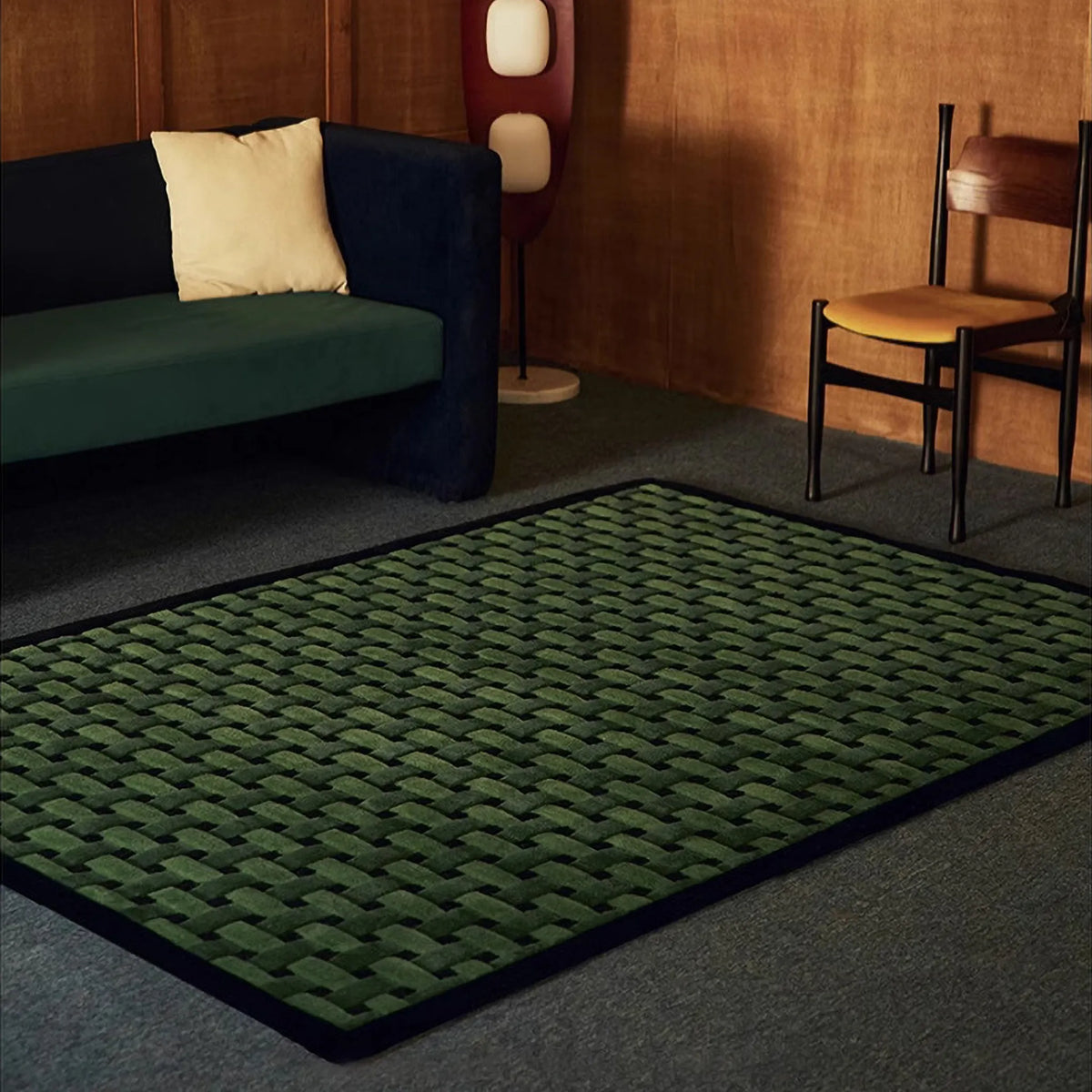
Green has an easy place in a kitchen. It brings in a natural note without pushing the room into "decorated" territory. It sits easily with white cabinets, wood shelves, cream walls, terracotta pots, herbs on the windowsill and the everyday mess of a working kitchen.
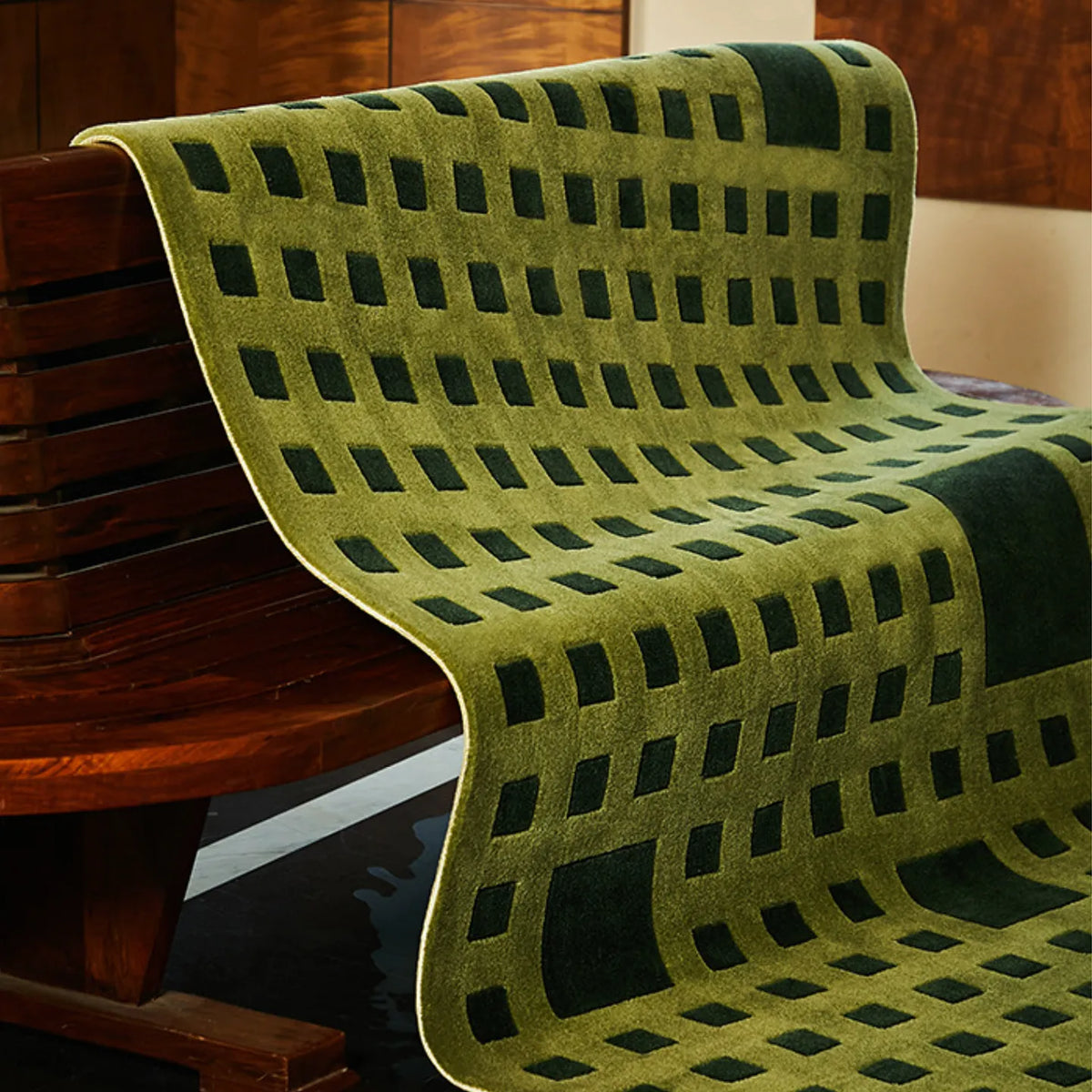
A green kitchen rug does not have to be bright. Olive, moss, sage and deeper green accents can freshen the floor while still feeling grounded. In a simple kitchen, green adds life. In a busier kitchen, a smaller green detail or a more structured pattern is often easier than a large block of colour.
A moss green kitchen rug like Merryn Green Moss Garden High Low Tufted Irregular Rug works best in a drier kitchen corner, breakfast nook or open-plan edge, where layered greens and high-low texture bring in a small garden feeling. It is the kind of rug that feels especially good first thing in the morning, when you pad over barefoot, set down coffee and toast, and ease into breakfast with a softer, more cushioned feel underfoot.


Wavy and shaped kitchen rugs
Kitchen layouts are full of straight lines. Cabinet fronts, tile edges, worktop runs, appliances and flooring seams create a grid before you add anything else. A wavy or shaped rug can soften that without relying on a busy print.
In a small kitchen, that softer outline can matter more than you expect. A curved edge, irregular outline or shaped border makes the floor feel less boxed in. It also makes the rug look chosen for the space, rather than placed there because the floor needed something.
Graphic or colourful kitchen rugs
A graphic or colourful rug can work in a kitchen, but it needs the right room around it. It is easiest with plain cabinets, a fairly clear worktop and no strong tile pattern already fighting for attention.
In that kind of space, colour can do a lot. It can make a white kitchen feel less clinical, give a rental kitchen more personality or turn a narrow floor strip into the part of the room that feels intentional. The problem comes when the kitchen already has dark cabinets, patterned tiles, open shelving and a busy counter. In that setting, a very loud rug can make the room feel busier rather than better.
If you prefer a softer, more rounded accent, Gala Tufted Rug works well as a peeled apple-shaped rug for a kitchen corner or smaller floor spot. If you want something more practical for a narrow kitchen run, Green Onion Playful Tufted Runner Rug brings the same playful cooking mood in a longer runner shape, with a darker ground that is easier to live with.


Where to place a kitchen rug and what size to choose
The right size depends on what the rug is meant to fix. A rug by the sink needs a different footprint from a rug beside a back door, and a utility corner needs a different shape from a narrow galley kitchen. For most small kitchen fixes, the choice is usually between a small rug and a longer runner.
By the sink
The sink area is usually the first place to consider. It is where you stand for washing up, rinsing vegetables, filling the kettle or cleaning up after cooking, so the rug has to feel useful rather than just decorative. A 50×80 cm rug is usually enough for a compact sink-side spot, while 60×90 cm gives a little more room underfoot.
The main thing is to leave the cupboards usable and keep the rug away from the wettest part of the sink. It should soften the floor without becoming something you have to keep moving out of the way.
By a back door or kitchen doorway
A back door, garden door or kitchen doorway can feel unfinished very quickly. Shoes, shopping bags, coats, bins and pet bowls often end up nearby, even when the rest of the kitchen is tidy. A small rug helps that entrance point feel more deliberate.
A 45×70 cm or 50×80 cm rug works for a compact doorway. A 45×120 cm rug may be better when the doorway leads straight into a narrow strip of kitchen floor. If this doorway is part of the route in and out of the home, the same entrance logic applies. A rug can make the transition feel less abrupt, especially where the kitchen meets a hallway, garden door or utility space. We looked at this more closely in Tidy Home, Bleak Hallway? Rugs That Make UK Entrances Feel Finished.
In a utility corner or coffee corner
A utility corner, coffee spot or small open-plan edge can take a little more personality. These are the places where a rug can do more than sit underfoot. It can mark out a small routine, like making coffee, sorting laundry or softening the join between kitchen and living space.
A 50×80 cm or 60×90 cm rug can define a small standing point. An 80×120 cm rug works better when the area starts to behave like its own little zone, such as a coffee corner, laundry area, breakfast nook or the soft edge between kitchen and living space.
For a narrow kitchen run
In a narrow kitchen, a small rectangle can feel too short. A runner can follow the line of the cabinets or the side of an island more naturally, which is where our runner rugs can be more useful than a single small rug.
A 45×120 cm rug works for a compact run or shorter worktop side. A 60×120 cm rug gives a little more width where the kitchen has room for it. A 45×150 cm rug starts to feel more like a proper narrow kitchen runner, especially in a galley kitchen or along a longer counter line.
Cleaning, grip and clearance still matter
A kitchen rug has to sit around real movement: cupboard doors opening, drawers sliding out, people turning with hot drinks, the dishwasher door coming down, someone stepping in from the hallway or garden. Before you get too attached to a colour or pattern, check whether the rug will actually sit comfortably in the space.
If the rug is near a low cupboard, drawer, fridge or dishwasher, leave enough clearance so the edge or raised pile does not catch. In busier spots, non-slip backing can help the rug feel more stable, though some floors may still need an extra rug grip underneath.
Care is worth checking rug by rug. Some kitchen-friendly styles may suit gentle machine washing, while others are better spot cleaned or hand washed. For the messiest parts of the kitchen, a more washable textured rug is usually the easier choice. For drier corners, coffee spots and open-plan edges, a softer tufted rug can bring more comfort and design value.
Choose the kitchen rug by the spot you want to fix
By the end, it usually comes back to one question: which part of the kitchen floor keeps bothering you?
Maybe it is the cold patch by the sink. Maybe it is the doorway that always feels a little unfinished, or the narrow strip of floor beside the cabinets that looks too bare. A utility corner may need something simple and easy to live with, while a coffee spot or open-plan edge can take a little more colour, shape or tufted texture.
If the kitchen already has a lot going on, warm neutrals, stripes, grids and quieter textures are easier to place. If the room feels too plain, green, wavy, graphic or colourful rugs can give the floor more character without changing the whole kitchen.
Our small rugs are a simple place to begin when you want a kitchen update that feels practical, comfortable and more considered, without turning it into a full kitchen project.


0 comments