

Key Takeaways:
- Start with footprint: runners suit true corridors, while small rugs finish the door-area patch neatly.
- Hallways usually feel more finished with structured, low-profile rugs than anything plush or tall.
- Low-contrast stripes and grids add boundaries that make an entrance look more organised.
- Warm off-whites, clean creams and soft oat tones tend to stay fresher than stark white in mixed hallway lighting.
- Wavy edges and softer outlines can ease a boxy hallway without adding colour.
- One well-placed rug is often enough to make the entrance feel finished.
By late winter, UK hallways have a way of showing every small weakness in a home. The living room can feel cosy, the bedroom can look fine, and the entrance still reads a little bleak. It is rarely because the space is messy. It is because the hallway is where light is thinnest and surfaces are hardest, with laminate, painted boards or tile underfoot, and a narrow footprint that makes everything feel more exposed.
A hallway rug is one of the few changes that shifts the mood without asking you to redecorate. It gives the eye a starting point, softens the floor, and makes the entrance feel properly part of the home. Not styled, not done up, just pulled together.


Start with the footprint, not the colour
Most hallway rug mistakes are not colour mistakes. They are footprint mistakes. In a typical UK home, the hall is either a true corridor that needs a runner, or a short entry zone where the front door opens straight into the living space and the hallway is basically one stubborn patch of floor that never looks finished.
When the hall is genuinely corridor-like, a runner does a job a small rug cannot. It turns that strip into a deliberate path, and that single move can make the whole home feel more organised because the entrance finally has direction.
A quick measuring note helps here. For a hallway runner, it usually looks best when you leave a small border of visible floor on each side rather than pushing the rug right up to the skirting boards. It also needs to clear the door swing, so measure from the threshold to where the door opens and aim to keep the runner sitting just beyond the area the door needs.
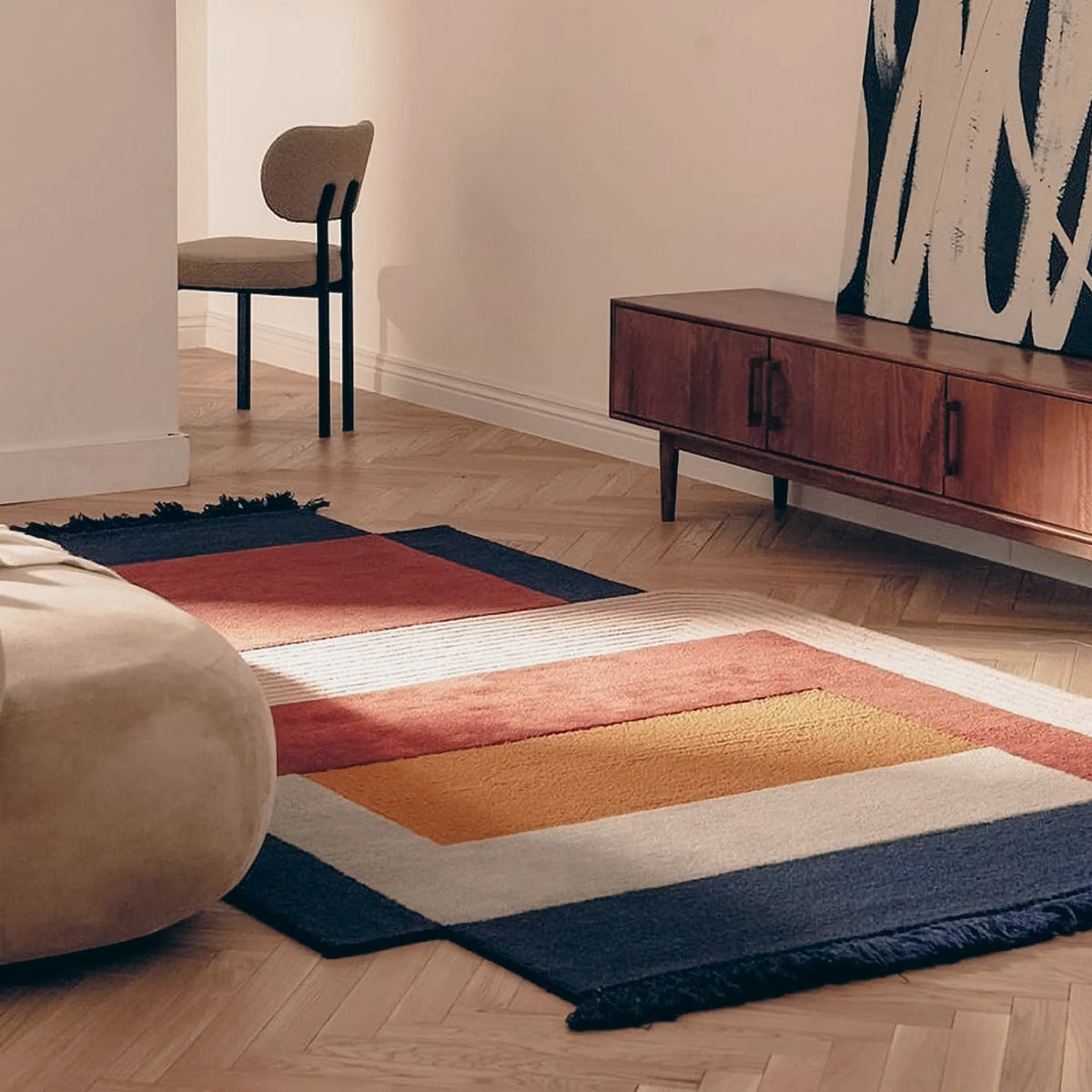
Soren Black Cream & Blue Block-Stripe Textured Rug is a strong example of how this works in real life. At 45×120cm, it sits comfortably in narrow walkways without swallowing the space, and the block-stripe layout gives the eye a sense of movement without turning the hall into a statement area.
Sometimes the space is really just the bit inside the door, not a corridor at all. In those homes, a runner can look like it is trying to invent a hallway that does not exist. A smaller rug usually looks cleaner because it finishes the exact area you actually use rather than stretching into a shape the space cannot support. The placement logic is the same one you cover in Small Rugs for UK Flats That Make Compact Spaces Feel Intentional. The hall does not need more things. It needs one anchor that stops it feeling accidental.
That is why a compact entry rug can be such a relief in winter. Maren Natural & Beige Fringed Handwoven Jute Rug and Maren Natural & Warm Brown Fringed Handwoven Jute Rug in 60×90cm work well for door-area entrances because they sit neatly by the threshold, read warm rather than cold, and make that always-bare patch of floor feel settled.


Hallways usually want structure, not plush
A hallway is not a room you linger in, but it is a space you live through. Shoes land there, bags drop there, and in winter the floor gets damp. In that context, anything too tall, too fluffy or too precious starts to feel irritating, even if it photographs beautifully. The rugs that tend to work best in hallways are lower-profile, stable underfoot, and easy to live with around a door swing.
Ivo Cream & Mocha Grid High-Low Textured Rug fits that brief particularly well. It has enough surface structure to stop the floor reading as one flat plane in grey light, but it does not turn into fluff that catches every footprint. It stays calm and practical, and it makes a hallway feel finished without demanding the rest of the entrance become a design moment.
A natural weave can do a lot of unglamorous work at the threshold, too. In smaller sizes, jute behaves like a proper entry rug, and it looks comfortable against practical UK flooring in a way that does not feel fussy.


The finished feeling usually comes from boundaries
Hallways can look messy even when they are not. Coats can be hung, shoes can be lined up, keys can be in a tray, and the entrance still feels visually noisy. The issue is often that everything is visible at once, but nothing gives the eye a boundary. A rug can solve that, not by adding more colour, but by creating a frame.
Pattern helps when it is doing structure rather than shouting for attention. Low-contrast stripes and grids give a corridor rhythm and a clear edge, which makes the space feel deliberate rather than exposed. Elio Beige & Navy Striped High-Low Textured Rug is a good example of a pattern that behaves like a neutral. At a glance it reads calm, but the stripe does the organising, so the hallway looks more pulled together simply because the floor now has a sense of purpose.
You already unpack the deeper reasoning behind this in Why Geometric and Checkered Rugs Make UK Homes Feel Warmer (and Less Messy) in Winter. The useful takeaway for hallways is simple. Pattern can calm a space when it acts like a boundary rather than a feature.
Contrast also changes as the light drops. A pattern that looks crisp on a bright screen can feel sharper at 5pm in February, especially in a north-facing hallway or under warm bulbs. That is why calmer hallway patterns tend to be low-contrast, with structure doing the work instead of colour.


Lighting is why some neutrals disappoint
Hallways often have two lighting moods: cool daylight from one end, and warm ceiling light in the evening. Both can distort neutrals, which is how people end up with a rug that looked clean online but feels oddly dull in real life.
North-facing daylight can pull beiges grey. Warm bulbs can push other beiges yellow. Neutrals that hold up best across those shifts are usually warm off-white, clean cream and soft oat tones, especially when the surface has a little texture. Texture gives the eye something to read when the light goes flat.
A short hallway that needs a softer feel than jute often suits a tufted neutral that still has definition. Eira Off White Irregular Cloud Patch High Low Tufted Rug makes sense as a transitional piece in 80×160cm when the entrance is not the main shoes zone, or when a small doormat takes the wettest job and the softer rug sits slightly further in.


Shape can relax a hallway without adding colour
UK hallways are full of straight lines: skirting boards, door frames, radiator edges, cabinet corners. In a narrow space, another strict rectangle can reinforce that boxed-in feeling, even when the rug itself is neutral. Shape can soften that geometry without asking the room to take on more colour.
A softer outline does this quietly. Alba Sand & Cream Wavy Edge High-Low Tufted Runner Rug works well in a corridor because it still behaves like a proper runner at 74×180cm, but the wavy edge takes some tightness out of the space. You have already explored the idea in Why Wavy Rugs Feel Right in UK Homes (Even When the Room Isn't Perfect), and it applies especially well to hallways because they tend to be the most rigid part of the home.
Some entrances are corners rather than corridors. In those homes, a shaped rug can do the same softening job in a smaller footprint. Maisie Cream & Pale Blue Floral Shaped Tufted Rug in 80×80cm is not trying to be a runner. It is there to soften the first step and make that entry corner feel cared for, which is often all a small UK entrance needs.


One finished patch of floor is usually enough
A hallway rug does not need to solve the whole entrance. Most of the time, one spot is responsible for the unfinished feeling: the cold patch inside the front door, the strip that makes the corridor feel empty, the bit that still looks bare even after you tidy.
Pick that one area and make it work, then leave it alone for a week. When the entrance looks settled, the rest of the home often reads as more pulled together, even if nothing else changes.
For runner sizes and hallway-friendly styles, start here: Shop All Runner Rugs.


0 comments