

Key Takeaways:
- Wavy rugs suit UK homes because most spaces are not perfectly symmetrical.
- Curved edges soften awkward layouts rather than highlighting them.
- Wavy rugs work naturally within the broader family of irregular rugs.
- In living rooms, wavy shapes accept furniture drift instead of forcing alignment.
- Curved outlines soften pattern, making black and white and checkered rugs easier to live with.
- Wavy rugs interact more gently with low, angled UK light.
- Smaller spaces and hallways benefit from softened edges.
- When shape does the work, colour feels more balanced and less dominant.
Wavy rugs are appearing more often in UK homes for a simple reason: most British spaces are not neat boxes. Living rooms are rarely centred, doorways are often off-axis, and furniture tends to sit where it fits rather than where it should. In homes like these, a wavy rug does not look unusual. It looks right.
UK homes are not built around perfect lines
Most UK homes are shaped by compromise rather than symmetry. Bay windows pull one side of a room forward. Radiators interrupt walls. Sofas sit slightly off centre because that is the only place they work. When a straight rug is placed into this kind of space, it often highlights imbalance instead of resolving it.
This is where a wavy rug or wavy carpet behaves differently. Instead of reinforcing straight edges, it softens them. In a living room that already feels a little awkward, wavy rugs for living room use tend to settle the space visually rather than divide it up. The room stops feeling like something is slightly wrong, even though nothing structural has changed.
This is also why wavy rugs sit so naturally within the broader family of irregular rugs, rather than standing apart from them. They do not correct space. They adapt to it. The same logic runs through many of the irregular rug styles that have quietly become more common in UK interiors over recent years, a shift explored further in our article on The Quiet Rise of Irregular Rugs.
Wavy rugs change how edges behave
A wavy rug does not try to impose order on a space. It responds to it.
The key difference lies at the edge. A wavy edge rug or wavy border rug breaks the expectation that a rug should form a hard boundary. The eye does not stop sharply. It moves more gradually, which makes the floor feel less rigid and the room less boxed in. This is why wavy rugs often feel calmer, even when colour or pattern is strong.
In pieces like Nova Black White Modern Irregular Wavy, the curve is not decorative. The edge itself defines how the rug sits in the room, which is why it feels more settled in off-centre living spaces. Softer designs such as Cora Off White Irregular Wavy or the Coquille seashell-shaped rugs show this even more clearly. Their outlines do not frame the floor. They dissolve it.
Wave edge rugs and wave border rugs act as a visual buffer. Instead of drawing a straight line around furniture, the edge absorbs small inconsistencies in layout. That effect is spatial rather than stylistic, and it explains why these rugs feel easier to live with over time.
Living rooms rarely sit in neat rectangles
In many UK living rooms, furniture does not align cleanly. Coffee tables drift. Armchairs angle slightly. Sofas are pulled away from walls to avoid radiators or windows. In these conditions, a rigid rectangular rug can feel disconnected from how the room is actually used.
Wavy rugs for living room spaces work because they accept this drift. A wavy irregular rug does not fight uneven spacing. It allows furniture to sit naturally, without forcing everything to line up. This is why wavy and irregular rugs are not opposites. They solve the same problem from the same direction.
Pattern behaves differently as well when the edge is curved. In checkered designs like the Noor series, or scalloped styles such as Arden, the wavy outline softens the rigidity of the pattern itself. This is why a black and white wavy rug feels calmer than a straight-edged equivalent, even when contrast is strong.
The same effect explains why checkered and geometric patterns often feel warmer and less messy in UK homes, something we explore in more detail in Why Geometric and Checkered Rugs Make UK Homes Feel Warmer. The curve absorbs visual tension before it builds, allowing pattern to feel intentional rather than overwhelming.
Light and shadow matter more in UK homes
Light plays a larger role in how rugs are perceived than most people realise, particularly in the UK. Natural light often enters rooms at a low angle, especially during winter. Straight edges catch light sharply, which can make floors feel harder and more exposed.
Wavy rug design behaves differently under the same conditions. Curved outlines catch light unevenly, creating softer transitions between light and shadow. A wavy pattern rug does not rely on decoration or heavy contrast to add depth. The shape itself does the work. If you're drawn to curved shapes because they soften winter light, green rugs often amplify that calming effect. We explore this more fully in Why Green Rugs Feel Calm, Not Cold in UK Homes.
This is one reason impressions for wavy rugs appear even when people are not actively searching for trends. The effect is visual and physical rather than stylistic, which makes it more durable over time.
Small spaces and hallways benefit quietly
Wavy rugs also work surprisingly well in smaller or awkward spaces. In narrow areas, a small wavy rug feels less restrictive than a straight one. The curved edge gives the impression of more room to breathe, even when the footprint is the same.
The same logic applies to hallways. A wavy hallway runner does not force the eye into a strict corridor. It softens the path and makes the space feel less like a passage and more like part of the home. These are not high-volume searches yet, but they are natural extensions once wavy rugs are understood as a spatial solution rather than a decorative choice.
Colour works differently on a wavy base
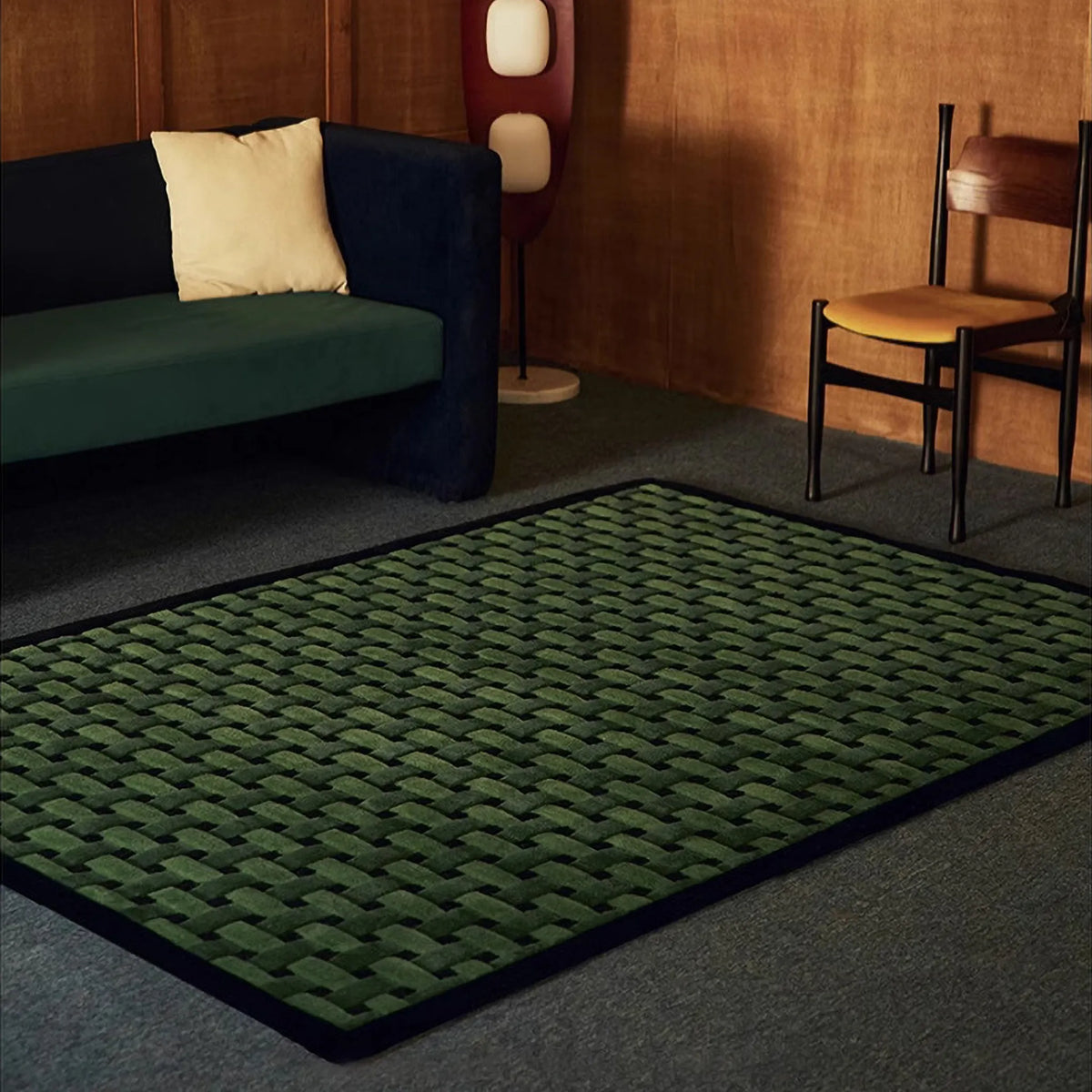
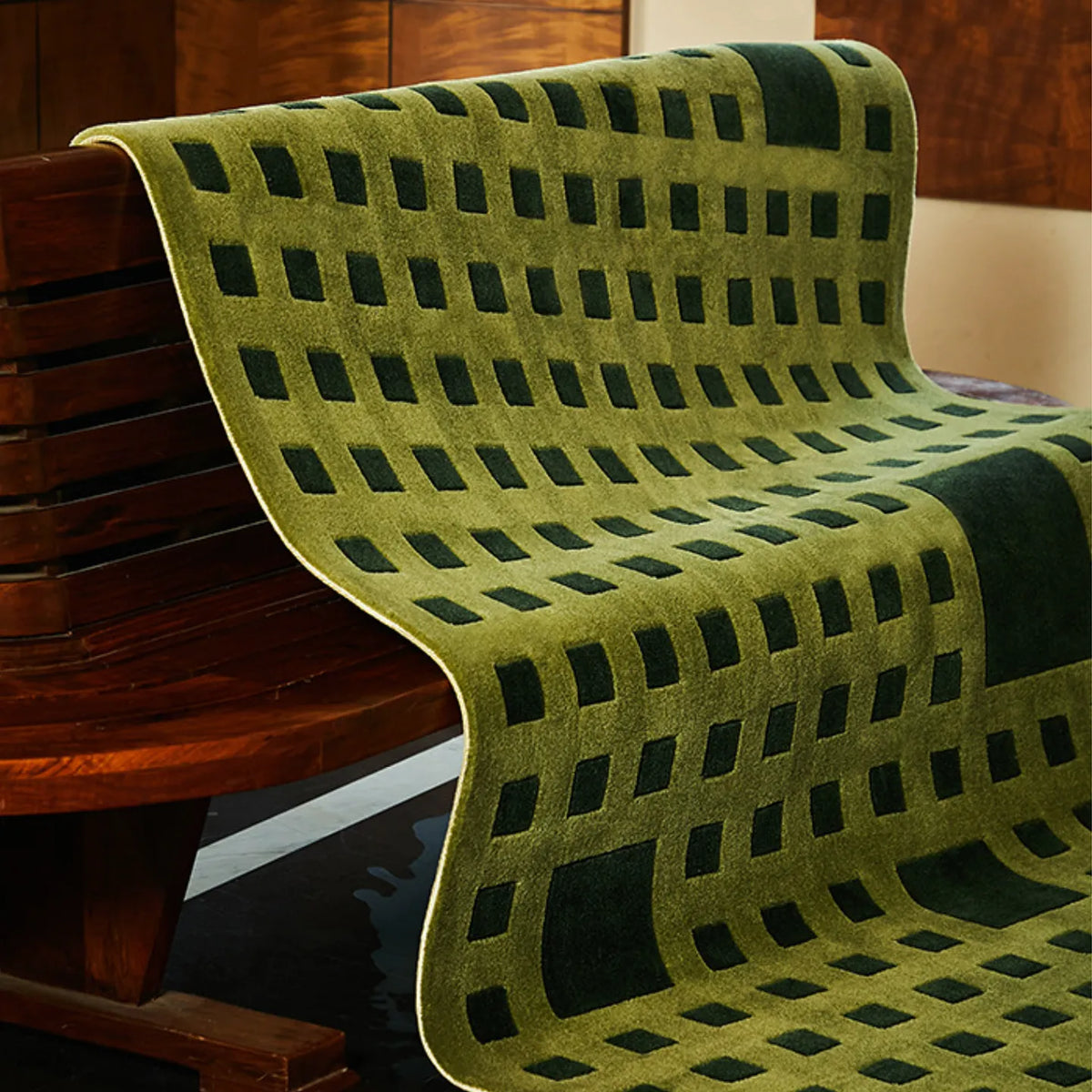
Once the shape is doing the work, colour becomes easier to live with. A green wavy rug can feel grounded rather than heavy because the curved outline prevents the colour from dominating the room. This balance is why green rugs work so well in UK interiors, as explored further in How to Style Green Rugs for Calm & Character at Home.
The same principle applies across many green rugs, where shape plays as much of a role as shade. When edges are softened, colour settles into a space rather than taking it over.
A black and white wavy rug behaves in a similar way. The curved outline interrupts contrast before it becomes too strong, which is why black and white rugs with softer edges tend to feel more liveable in everyday rooms.
This is why wavy rugs sit comfortably alongside stronger colour stories. The form creates balance before colour even enters the conversation, allowing wavy rugs to integrate naturally with green rugs and black and white interiors without overwhelming the space.
Why wavy rugs feel right
Wavy rugs do not succeed because they are unusual. They succeed because they align with how UK homes are actually built and lived in. When a space already has uneven edges, imperfect symmetry and soft, angled light, a rug with soft boundaries simply makes sense.
If a room feels decorated but not quite settled, the issue is often not colour or furniture. It is the shape that holds everything together. If you are exploring this approach, you can see how different shapes behave across our Wavy Rugs Collection.


0 comments