

Key Takeaways:
- A multicoloured rug does not usually feel messy because it has several colours. It usually goes wrong when the colours feel too scattered, too sharp, or too loud for the room.
- In UK homes, multicoloured rugs are often easier to live with when one colour leads and the others support it.
- Green-led, blue-green, and muted earthy mixes usually hold up better in grey UK light than very bright, high-contrast colour combinations.
- A multicoloured rug often works best when it carries most of the colour on its own, rather than asking the whole room to repeat it.
- In compact UK homes, one clear patch of colour is often more effective than trying to make the whole floor expressive.
- Before buying, check whether the rug still reads clearly when the light drops and whether you like the whole design, not just one striking detail.
At this point in the year, a lot of UK rooms start to shift a bit. Winter is not fully gone, but the light no longer sits as heavily as it did in January. People start wanting more colour again, though usually not in a dramatic, start-over way. It is often just a feeling that the room could do with a bit more life.
This is often the point when multicoloured rugs start looking more appealing, and also when people get wary of them. A multicoloured rug can look lively on a screen, then feel far too busy once it lands in a real room. That matters even more in UK homes, where the light is often softer, flatter, or just more changeable through the day. A rug that feels cheerful at noon can look much more broken up by late afternoon if the colours are too scattered or too sharp against each other. What matters is which kind of multicoloured rug can add colour without making the room feel more restless.


Why multicoloured rugs can feel harder to get right in UK homes
Part of the problem is that people often talk about multicoloured rugs as if they all behave in the same way, when they really do not. Some multicoloured rugs add colour in a soft, grouped way. Some feel much more graphic. Some are playful and small and work almost like an accent on the floor, while others are large enough to shape the mood of a whole zone. Once all of that gets collapsed into one category, it becomes easy to say multicoloured rugs are hard to use, when the real issue is usually scale, contrast, and where the rug is going.
UK homes complicate that a bit further. Many flats and terraces are not especially big, and rooms often do more than one job. The entrance is narrow, the living room may also have to double as a dining space, and the floor ends up carrying more visual weight than people realise. If a multicoloured rug feels overworked, the room can start to feel crowded too.
It is also worth saying that "busy" is not just about the number of colours in a rug. A small graphic rug with strong lettering can feel louder than a much larger multicoloured rug in several related tones. What matters more is whether the rug still reads as one thing when you look at it, or whether it breaks up into lots of competing bits. If a room already feels visually full, a multicoloured rug will need more care. If the room feels plain, washed out, or just a bit flat, the right one can do a lot very quickly.
What makes a multicoloured rug feel calm rather than messy
The multicoloured rugs that are easiest to live with usually do not hit every colour at the same volume.
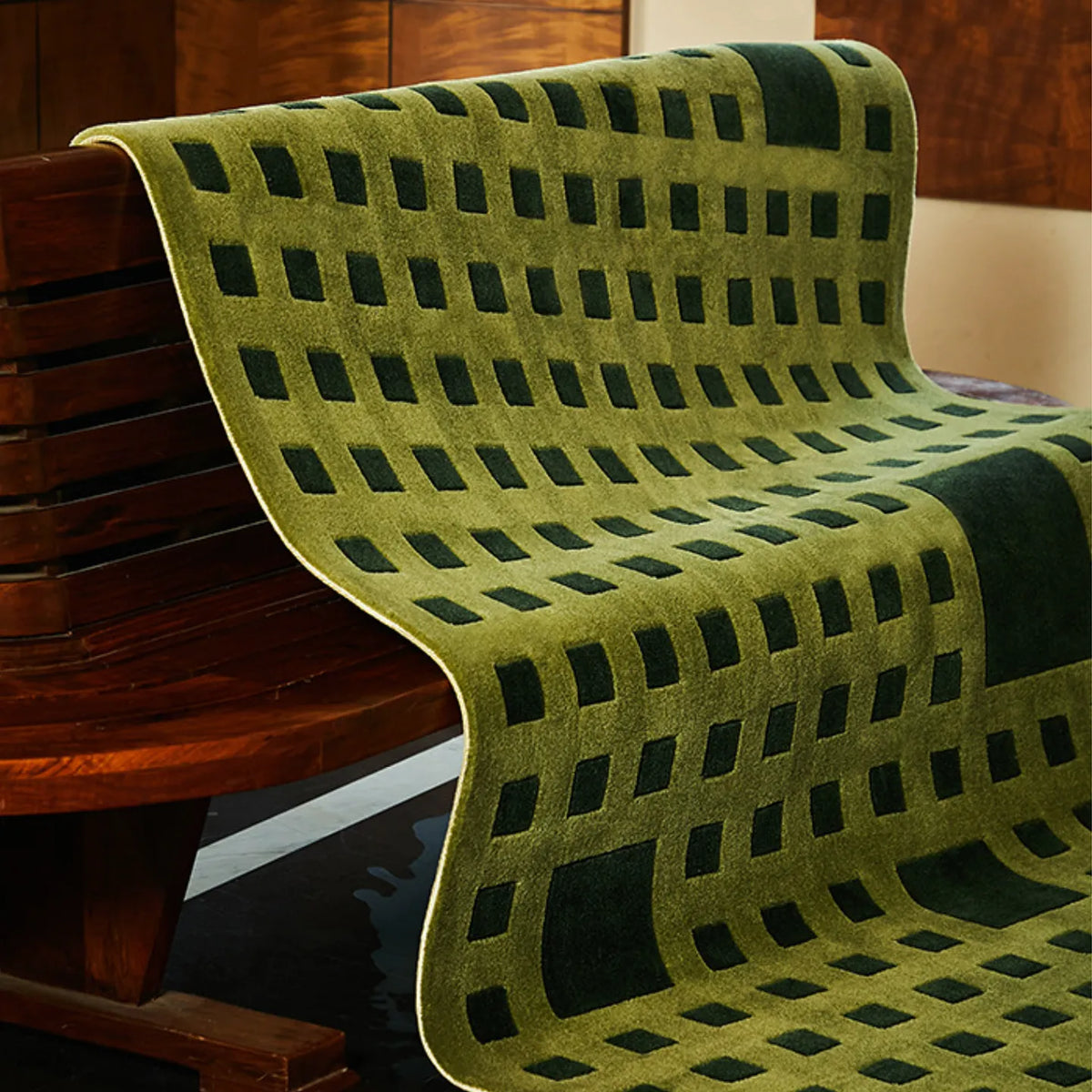
You can see that clearly in the Merryn Green Moss Garden Round High Low Rug. It is unmistakably multicoloured, but green still leads. The other colours sit inside the design rather than splitting it apart, so your eye does not end up bouncing around looking for somewhere to settle. That is often the difference between a multicoloured rug that feels layered and one that feels restless.
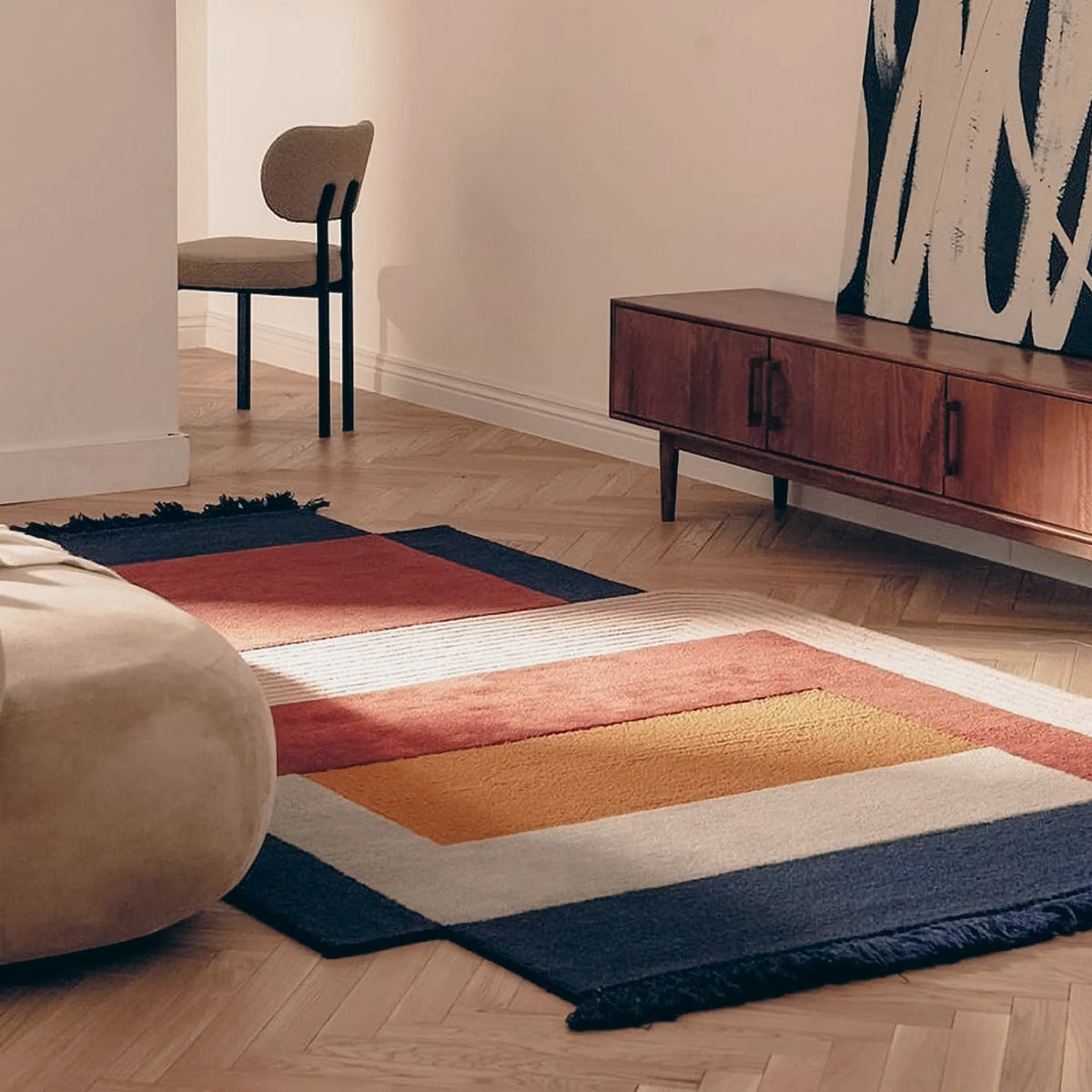
With the Noor Blush Pink Ivory Checkered High Low Wool Rug, the calm comes from somewhere else. It is less about one flowing field of colour and more about order. The checkered structure holds the colours in place, so even with the variation, the layout keeps the whole rug under control. It feels intentional rather than scattered.
People who like the idea of colour but still want a room to feel neat often end up responding well to checkered rugs. If that is you, our post on How to Use Checkered Rugs to Make a UK Room Feel Calm and Pulled Together goes further into that side of it.
In practical terms, a multicoloured rug usually feels calmer when one colour is doing most of the work, when the colour changes happen in grouped areas rather than tiny fragments, and when the design still makes sense from a distance. You should not have to stand there decoding it.


The kinds of colour mixes that hold up best in grey UK light
A lot of rug advice gets vague here, because it starts talking about colour in general instead of talking about what certain multicoloured rugs actually do in real UK light.
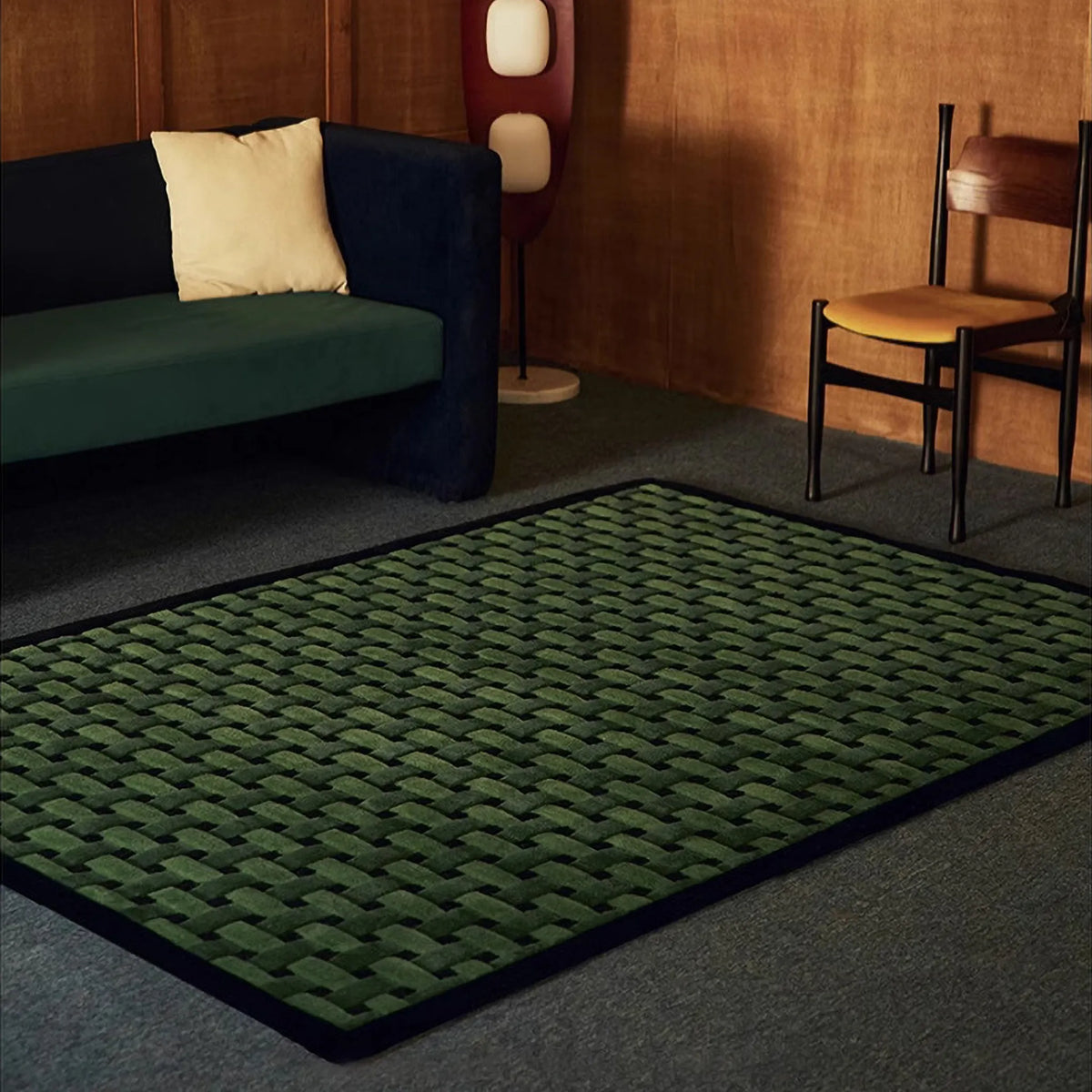
Bright colour is not automatically wrong in a UK home, but some multicoloured rugs are simply easier to live with when the light is not strong for most of the day. Green-led mixes tend to do especially well. They usually still feel grounded when the room is grey, and they do not need direct sun to look complete. The Marlow Deep Green Mossbank High Low Irregular Rug leans into exactly that kind of colour mix. There is variation in it, but it stays inside a mossy, pond-like range that still feels connected. You get life from the colour without the rug tipping into anything sugary or overexcited.
The Orla Blue & Green Floral Shaped High Low Rug takes the palette a little further. The blue and green combination gives more contrast than an all-green multicoloured rug, but it still feels coherent. In a small or medium patch of floor, that can be exactly the right amount of colour. It feels more expressive than plain neutral, without making the room feel noisy every time you walk in.
That helps explain why green rugs keep coming back in UK interiors. They usually sit more comfortably in grey light than brighter, harsher combinations do. If you want to explore that side further, Why Green Rugs Feel Calm, Not Cold in UK Homes is worth reading alongside this one, or you can browse our Green Rugs collection for more of that palette direction.
Muted earthy mixes also tend to last well. Moss, sage, dusty blue, off-beige, rust, chocolate, softened mustard. Those kinds of colours often stay easier on the eye over time than multicoloured rugs that rely on very bright contrast. That does not mean every multicoloured rug has to be soft and nature-led. It just means that if you are nervous about trying more than one colour for the first time, these are usually easier places to start.


How to add more colour without making the whole room feel full
One of the easiest ways to make a multicoloured rug go wrong is trying to spread its colour story all over the room. That is often the point where things tip from lively into overdone.
If you bring in a multicoloured rug, let the rug do most of the work. You do not need to repeat every tone in cushions, art, throws, and accessories. Most rooms look better when you do less than that. Often, one repeated colour is often enough, and two is usually plenty.
The Vera Pastel Green Orange Gingham Scalloped Rug is good at this because it brings in colour and pattern without shouting for attention. In a 160 x 230 size, it can shift the feel of a room quite a bit without making the whole space feel crowded. It works best in rooms that are already fairly plain, where you want the rug to be the place things get gentler, warmer, and a bit more awake.
It also helps to look at what is happening right around the rug. If the multicoloured rug already has movement and colour in it, the area around it usually benefits from some quiet. That might mean a simpler coffee table, fewer objects clustered at the edges, or just a little more visible floor than you would normally leave.
Neutral rooms often make a good base for multicoloured rugs. That does not mean the room has to stay beige forever. It simply means colour tends to land better when something calmer is already supporting it. Our post No Sun, Still Want Your Flat to Look Sorted? Try Neutral Rugs explains that side of things in more detail, and our Neutral Rugs collection is a useful place to start if you want a quieter base before bringing in more colour.


Where multicoloured rugs work best in compact UK homes
With multicoloured rugs, size matters more than people often expect, especially in smaller UK homes. A lot of the time, the best use of a multicoloured rug is not covering the whole room. It is giving one part of the room a lift.
In this kind of space, the Freya Multicoloured Moss Green Floral High Low Rug feels much more convincing than a larger, more demanding piece. At 120 x 180, it is not pretending to solve a huge open-plan room. What it can do is wake up a small seating area, a studio flat living zone, or a bedroom corner that feels flat but not cluttered. In that sort of space, a medium-sized multicoloured rug is often enough.
The runner format helps for similar reasons. Take the Merryn Green Moss Garden High Low Irregular Runner. In narrow spaces, this kind of multicoloured rug often works better than people expect. Hallways, side passages, and slim zones in UK homes tend to feel functional first and attractive second. A runner can change that quite quickly, and because the colour is kept inside a long, defined strip, it usually feels more controlled than putting a multicoloured rug in the middle of a wider room.
Hallway rugs deserve more credit than they usually get. If your entrance or narrow walkway needs help, Tidy Home, Bleak Hallway? Rugs That Make UK Entrances Feel Finished is the most relevant next read.
Small rooms can absolutely take colour, but they usually handle it better when it arrives in one clear area rather than across the whole floor.


How to tell whether you will still like a multicoloured rug after the first week
It is worth asking, because a lot of rugs are easy to like for five minutes and much harder to live with after that.
The first test is what happens when the light drops. If the room turns a bit flat in the late afternoon, does the multicoloured rug still read as one design, or does it start to feel bitty? That matters more in real life than a perfect product photo ever can.
The second test is whether you are drawn to the rug as a whole, or just to one loud detail. If one small feature is doing all the work, the rug can wear thin quickly. If the overall colour relationship still feels good after a few looks, that is usually a better sign.
The third test is whether the rug leaves room for the rest of the house to exist. The Elora Moss Green Round Mushroom Tufted Rug is the kind of piece that helps explain the difference. It has charm and colour, but it does not ask the whole room to rearrange itself around it. That quality matters. The multicoloured rugs people keep loving are often not the ones that make the strongest first impression. They are the ones that keep fitting in as you live around them.
A good multicoloured rug should not feel like a styling stunt. It should still feel easy to live with once the novelty wears off.


So, are multicoloured rugs a good idea in UK homes?
They can be, but it depends on the kind you choose. Some multicoloured rugs make a space feel more alive. Others just make it harder to settle.
In UK homes, the easiest place to start is often with a multicoloured rug that still feels connected. One main colour should be doing most of the work, with the others supporting it rather than fighting for attention. That might mean a green-led round rug, a checked design with some structure, a medium floral rug for a compact seating area, or a runner that brings colour into a narrow space without taking over the whole room.
If your room already feels cluttered, multicolour will need a bit more restraint. If your room feels flat, grey, or slightly tired, the right multicoloured rug can shift the mood surprisingly fast without asking the whole room to do too much.
If you want to explore the options, browse our multicoloured rug collection and start with the kind of colour mix your room can actually hold.


0 comments