

Key Takeaways:
- Choose a size that keeps the wavy edge visible once your sofa and coffee table are in place. If the curve disappears under furniture, the rug will look awkward rather than intentional.
- Aim for the sofa’s front legs on the rug in most UK living rooms. It anchors the seating area and makes the room feel finished.
- In small UK flats, wavy rugs can work even better, as long as the outline is not pinned down. Pick a size where the curve can breathe on at least one side.
- Keep the look calm by balancing shape with colour. Monochrome and gentle contrast make wavy edges feel grown-up, not cute.
- Use pattern for order, curve for softness. A geometric or checkered design can ground the room while the wavy outline stops it feeling strict.
- If your room already feels busy, simplify the rug choice. Bold word or graphic rugs can work, but only when everything else stays quiet.
If you have ever looked at your living room and thought everything is technically “fine”, yet the room still feels a bit stiff, you are not imagining it. UK homes are full of straight lines. Sofas sit square to the wall, TV units run flat and long, fireplaces are rigid blocks, bay windows pull the layout off centre, and then we put a perfectly rectangular rug underneath it all. Even a cosy space can end up feeling slightly boxed in.
That is why wavy rugs have quietly become a favourite. A curved edge does something small but real. The key is choosing a size that keeps the curve visible once your furniture is in place. It softens the hard geometry without making the room feel themed or over-styled. It also makes the layout feel more forgiving, which matters in UK living rooms where not everything can be centred neatly.
We can use a very simple example to see the effect. Cora Off White Irregular Wavy Shaped Rug is the sort of wavy shape that works with almost anything. On wood floors with a neutral sofa, it reads calm rather than cute. It does not shout for attention. It just makes the whole room feel less rigid.
If you want to see what that looks like across different colours and shapes, you can start here: Shop wavy rugs.
What counts as a wavy rug and why people also search “wavy carpet”
When people say “wavy rug”, they usually mean one of two things. The first is a rug with a wavy outline, where the outer edge curves in and out like a soft ripple. The second is a rug with a clean body but a wavy border or scalloped edge, so the straight rectangle is broken up at the edge.
In the UK, plenty of shoppers also type “wavy carpet”. It does not always mean wall-to-wall carpet. It is often just how people describe something soft underfoot in the living room. If you have searched both, you are not the only one.
The practical point is this. In a living room, the edge of the rug is what your eye notices most. A wavy edge is not only a style detail. It is a layout tool. It can make a room feel less strict, even when the furniture is not perfectly aligned.
How to choose the right wavy rug size for a UK living room
A wavy rug works best when the outline has room to read as a curve, not a straight edge. If the rug is too small, the edge gets swallowed by furniture and you lose the whole point. If it is too large, the curve can end up pushed against walls and, again, it disappears.
In most UK living rooms, the simplest rule is this. Choose a size that lets the front legs of the sofa sit on the rug, and gives the wavy edge some breathing space on at least one side. It makes the seating area feel anchored without feeling tight.
If you are working with a small room, do not assume a wavy rug is “too much”. Small spaces are where wavy edges often look best, because they soften harsh corners and help a compact layout feel less boxy.
And this is where people accidentally go wrong. In a smaller living room, wavy rugs fail when the curve is pinned down and hidden. Cora Off White Irregular Wavy Shaped Rug is a good example of the opposite. The outline is clear, so when you choose a size that allows the sofa’s front legs to sit on the rug, the curve naturally stays visible. The room looks more complete, but it still feels light.
If you are working with a tighter footprint, it is worth starting with small rugs for UK flats, then choosing a wavy shape where the curve stays visible once the furniture is in.
A useful way to think about size is to ask what you want the rug to do. If you want it to connect the sofa and coffee table into one calm zone, size up so the coffee table sits comfortably within the rug area. If you want the rug to be a softer accent that breaks up hard flooring, smaller can work too, as long as the wavy edge remains visible and not trapped.
Where a wavy border works best in real UK layouts
Most people do not have a perfectly symmetrical living room. You might have a bay window that pushes furniture off centre, a fireplace that forces the sofa to one side, or a doorway that cuts through the space and limits where anything can sit.
This is exactly where a wavy rug makes sense. If your sofa is slightly off centre, a curved edge makes that feel intentional rather than wrong. If you have a fireplace, a gentle curve can soften the hard rectangle of a hearth and stop the room feeling like it is made entirely of right angles. If you have open-plan living, a wavy outline can mark the seating area without creating a hard border that feels like a mat.
One thing to avoid is trapping the wavy edge under heavy furniture. If the curve is the design feature, let it be seen. Even leaving one side clear, such as the outer edge facing the room rather than the edge pushed up against a wall, is enough to keep the shape doing its job.
How to keep wavy rugs calm, not childish
This is the worry people rarely say out loud. Wavy shapes can look playful, and nobody wants their living room to feel like a kids’ space.
The easiest way to keep it grown-up is to let the shape do the work, then keep everything else calm. Neutral tones, gentle contrast, and simple patterns make the curve feel designed rather than cartoonish.
If you are unsure, monochrome is the safest route. It gives the room structure, while the wavy outline adds softness. Nova Black White Modern Irregular Wavy Shaped Rug shows this perfectly. The curve relaxes the space, but the black and white contrast keeps it sharp and intentional. In a living room, it reads as a proper design choice, not a novelty.
You will find the easiest options in our black and white rugs collection, especially if you want the curve to feel grown-up rather than cute. And if you want a deeper guide to making monochrome feel warm and liveable, read how to style black and white rugs in UK homes.
Geometry plus curve: how to add order without making the room feel strict
Some living rooms do not need more softness. They need more order. That does not mean you have to make everything plain. It just means your eye needs somewhere to settle.
This is why geometric pattern and a wavy outline can be such a good pairing. The pattern gives the room structure. The curve stops it feeling severe.
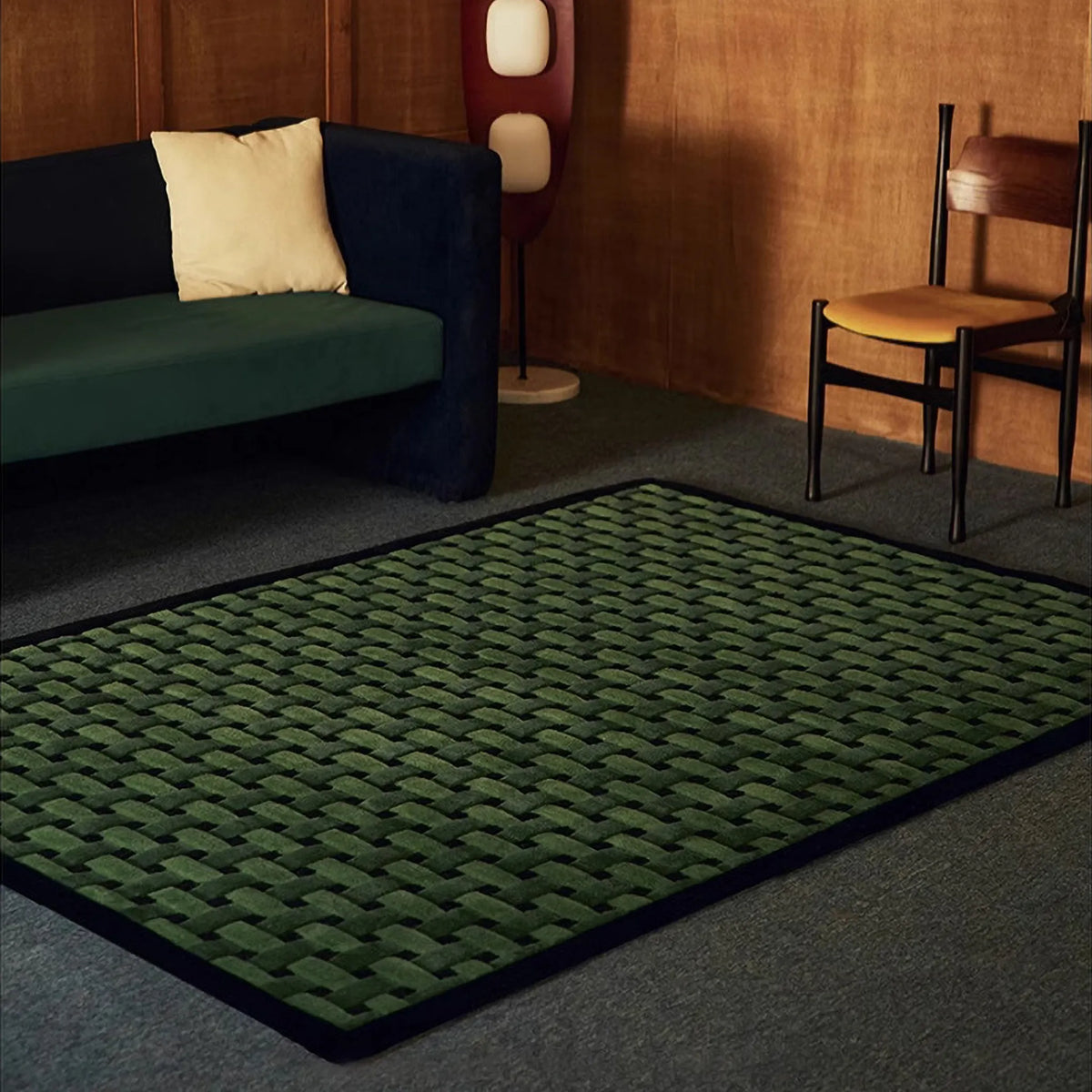
A rug like Noor Green Black Mint Checkered Irregular High Low Wool Rug makes the balance very easy to understand. The checkered pattern gives you a steady rhythm, so the room feels grounded. The outline and the high-low texture soften that grid, so it still feels relaxed. It is especially useful in UK living rooms with bay windows or slightly awkward angles, where straight lines do not quite line up anyway.
If you want the same idea in a quieter palette, Noor Brown Black Ivory Checkered does the job with less contrast.
If you like this balance of structure and softness, explore our geometric rugs, then come back to Noor as a good reference point.
Colour can still feel adult, if you choose the right kind
People often avoid colour because they fear it will look loud. The truth is, colour only looks childish when it feels sugary or chaotic. A deeper, more natural shade reads very differently.
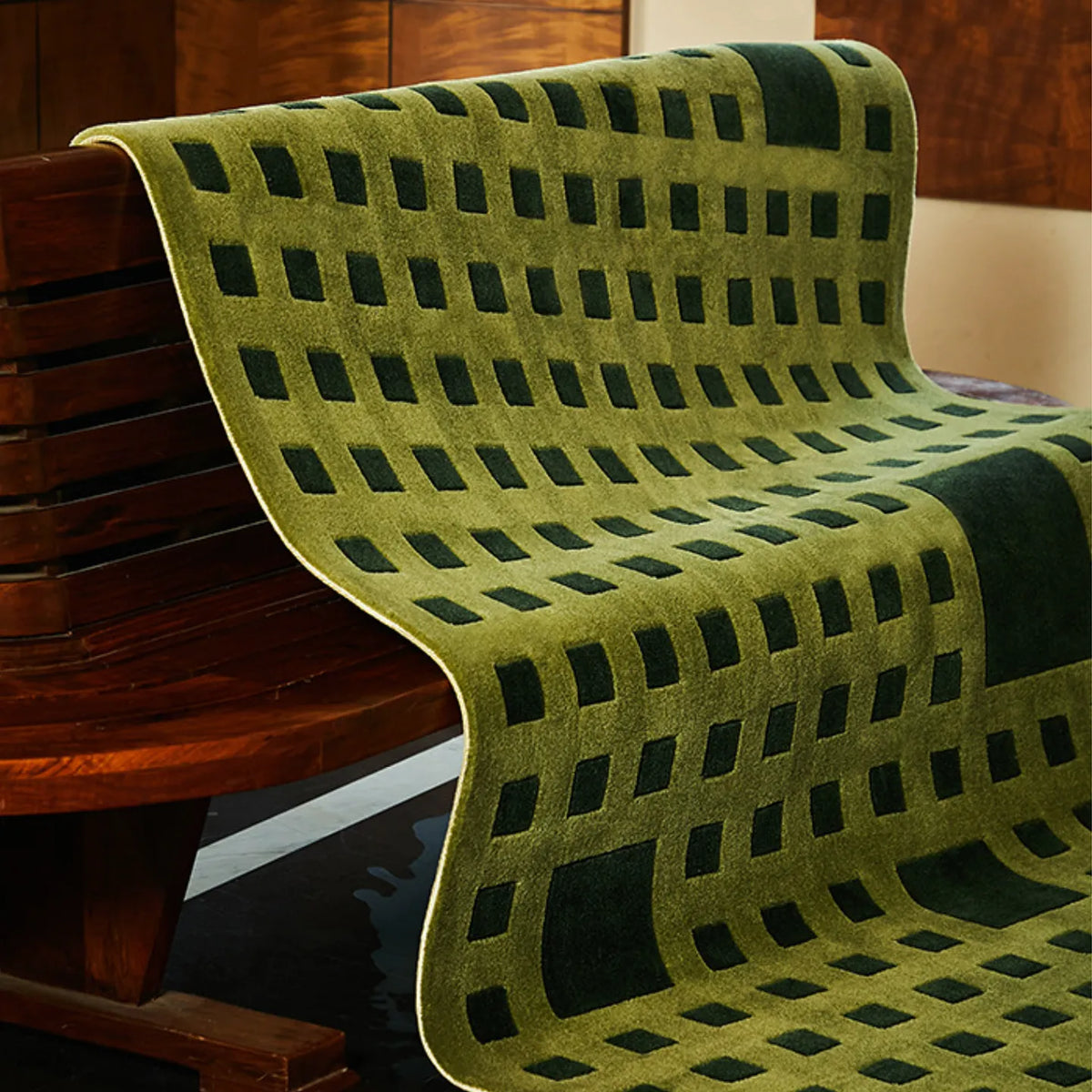
If you want warmth without noise, go for a colour that behaves like a neutral. Deep greens are brilliant for this. Verdure Deep Green Moss-Inspired High Low Rug is the kind of shade that settles a room rather than energising it. In winter light, especially, it adds depth and makes the living room feel more grounded, without you having to redecorate.
If your sofa is neutral, a richer green like this tends to look grown-up straight away, because it feels like a considered palette choice rather than a playful accent.
Wavy rugs vs irregular rugs: what is the difference?
A wavy rug usually reads as a deliberate border choice. It is a familiar shape made softer. An irregular rug is often more sculptural, more unexpected, and sometimes more playful.
If you want the room to feel calmer without changing the whole personality of the space, wavy is the easier entry point. It keeps your layout legible. It does not demand a theme.
If you already love bold shapes and you want the rug to be a focal piece, irregular shapes might suit you more. Coquille Cream Irregular Seashell Shaped Rug, for example, has a stronger “object” quality. It feels like a shape you place, rather than a background layer you add. The same goes for Coquille Green Cream Irregular Seashell if you prefer a little more colour in the outline. These are brilliant when the room is already quite simple and you want one piece that carries the personality.
If you want to see more sculptural shapes, it is worth browsing irregular rugs alongside wavy.
The common mistakes that make wavy rugs look off
The first mistake is buying too small. The curve disappears, and the rug looks like it is floating awkwardly in front of the sofa. If you are unsure, choose the size that allows the outline to remain visible, even after furniture is in place.
The second mistake is pairing a playful shape with an already busy room. If your living room has lots of strong prints, bright accessories, and mixed colours, a wavy rug can still work, but you will want a calmer palette or a simpler design so the room stays settled.
The same logic applies to bold word and graphic rugs. A rainbow DAMN word rug can be brilliant, but only when you have decided it is the main character. In a room that is already busy, it tips everything into noise. In a room that is clean and neutral, it becomes a single, confident focal point. So it is not hard to style. It just needs the space around it to be quiet.
The third mistake is pushing the rug hard up against every wall. A wavy outline needs a little negative space. Even a small margin helps the curve look intentional rather than cramped.
A few quick questions people ask before buying
Are wavy rugs good for living rooms?
Yes, especially in UK homes where rooms are often smaller and more defined. A wavy edge softens hard lines and makes layouts feel more relaxed, even when furniture is not perfectly aligned.
What is a wavy edge rug?
It is a rug where the outer border curves or scallops rather than forming a straight rectangle. The edge is the feature, and it changes how the whole room reads.
Can a wavy rug work in a small room?
Yes, and it can be surprisingly flattering in small rooms. The curve breaks up boxy corners and can make a compact space feel gentler. If that sounds like your room, start with our small rugs, because size and visibility matter more than anything.
Is a wavy rug the same as an irregular rug?
Not quite. Wavy feels calmer and more classic, while irregular is more sculptural. If you want to see the difference in one place, browse our irregular rugs and compare the silhouettes side by side.
Where to start if you want the look without overthinking it
If you want wavy in a way that feels easy to live with, start with a simple wavy border in a calm palette, and size it so you can actually see the curve. In a UK living room, that one detail can make the whole space feel more forgiving.
When you are ready to explore, browse all wavy rugs and choose the one that fits your room, not a perfect showroom.
And if you want the more “why it works” side of the story, you can also read why wavy rugs feel right in UK homes.


0 comments